
HB 2 intensity of service ratings, with the IEP quote behind every one
Under HB 2, intensity of service reporting follows what the IEP documents. See the IEP evidence behind every rating before it reaches PEIMS.
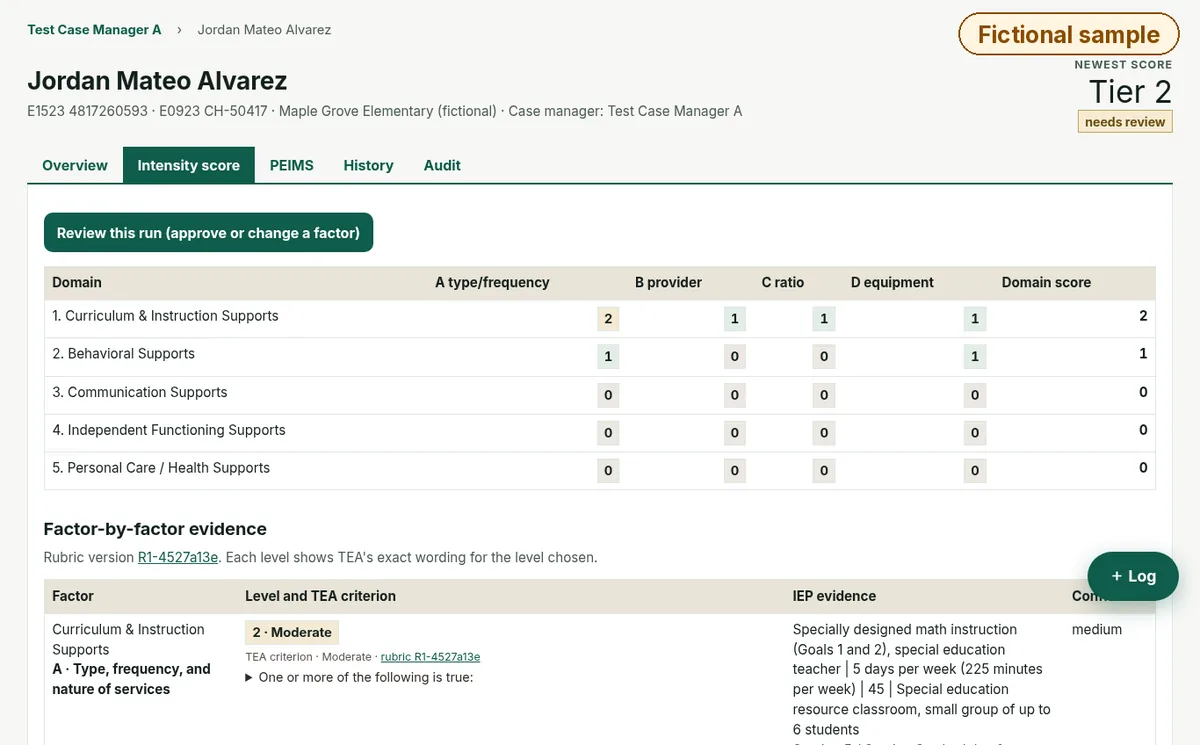
SpEd Insight™ reads each IEP and proposes an advisory intensity of service rating for each factor, quoting the line it came from. Your case manager approves or changes it. Your director exports a draft PEIMS prep file for your PEIMS staff to check. The rating never decides funding or services. Your ARD committee decides services, and the funding data follows what the IEP documents.
Demos use made-up students. Please don't send student information.
- Before any student data: your district signs the TX-NDPA. Student data will be loaded only after that.
- Where data goes: we will host on AWS in the US, with encryption. Student data will never be sold or used for advertising.
- IEPs are education records under FERPA. Under your district's signed TX-NDPA, records will stay under your district's direct control.
- How we handle data
Why now
- 2026–27 is the only dual-reporting year. Districts report the old instructional arrangement codes and the new tier of intensity, service groups, and average minutes per instructional day in a special education setting. (TEA, Apr 16, 2026)
- From 2027–28, funding uses only the new system. (TEA, Apr 16, 2026)
- Ratings come from what the IEP documents. Under 19 TAC §89.1121, effective Oct 4, 2026, a student is reported for the highest tier they meet, based on what the IEP documents as determined by the ARD committee.
How it works
- Upload an IEP, one at a time or in bulk.
- The AI proposes a rating for each factor in TEA's tool design (5 domains × 4 factors, 20 in all), with the IEP quote behind it.
- Your case manager approves or changes each rating, with a reason.
- SpEd Insight calculates the tier and service groups from the confirmed ratings.
- Your director exports a draft PEIMS prep file for your PEIMS staff to check.
See it with made-up students.
Demos use made-up students. Please don't send student information.
What you can see in the demo
- The IEP quote behind every rating
- The TEA source each rating follows
- An audit trail of who approved or changed what
- Built, in pilot prep. Demos use made-up students.
How drafts work
Every draft cites its source, and the educator confirms it. AI drafts are proposals for your ARD committee, including the parent, to review and decide.
Privacy. When a district signs the Texas Student Privacy Alliance's Standard Student Data Privacy Agreement (TX-NDPA), SpEd Insight will work with that district's student records as a school official under the district's direct control over how the records are used and kept. We will use student data only to provide the service to that district, will not re-disclose it except as the district directs or the law allows, and will never sell it or use it for advertising. No student data will be loaded until your district signs the TX-NDPA.
Security. SpEd Insight is being built around NIST CSF 2.0; AWS US; only HIPAA-eligible AWS services; encryption in transit and at rest; MFA. SpEd Insight is built for sign-in with your district's Google or Microsoft account. Multi-factor authentication will be required for every account before any student data is loaded.
Learn the HB 2 model
New to intensity of service funding? Start with our HB 2 and PEIMS hub, then read how intensity tiers and service groups work. Every guide cites TEA.
Questions
Does the AI decide funding?
No. The rating is advisory. The educator confirms every rating, and your ARD committee decides services.
What does 2026–27 dual reporting involve?
Districts report both instructional arrangement codes and the new intensity data through PEIMS this year only. See our explainer: The 2026–27 dual reporting year, explained.
Does it replace our PEIMS software?
No. Your director exports a draft file for your PEIMS staff to check and enter.
Which sources does it follow?
19 TAC §89.1121, TEA's New Intensity of Services Funding Model framework and TEA's published FAQ. Each rating above 0 shows the IEP quote behind it.
Who sees student data?
When a district signs the Texas Student Privacy Alliance's Standard Student Data Privacy Agreement (TX-NDPA), SpEd Insight will work with that district's student records as a school official under the district's direct control over how the records are used and kept. We will use student data only to provide the service to that district, will not re-disclose it except as the district directs or the law allows, and will never sell it or use it for advertising. No student data will be loaded until your district signs the TX-NDPA.
Does it work next to our IEP system?
Yes. SpEd Insight can be used alongside Frontline and other IEP systems; no integration required. Your IEP system stays the system of record. Drafts follow TEA Model IEP Form order so they're easy to copy in. This is a layout match only: SpEd Insight does not connect to or exchange data with your IEP system. Frontline is a trademark of its owner. SpEd Insight is not affiliated with or endorsed by Frontline Education.
Sources
- TEA To-the-Administrator letter, Special Education Funding Updates, Apr 16, 2026
- TEA Texas SPED Support, Intensity of Services Special Education Funding Model Resources, including the FAQ (updated Jun 2026)
- 19 Texas Administrative Code §89.1121, adoption published in the Texas Register Sept 25, 2026 (51 TexReg 6705; filed Sept 14, 2026), effective Oct 4, 2026 (TEA, 19 TAC Ch. 89 Subch. AA, October 2026 update); Texas Register adopted rules
- Texas Education Code §§48.102, 48.1021, 48.1022 (effective Sept 1, 2026), Texas Legislative Council
- TEA, New Intensity of Services Funding Model (June 2026), tool design with 5 domains × 4 factors
- Note: "20 factors" is TEA's tool design, not rule text.
19 TAC §89.1121, adopted 51 TexReg 6705 (Sept. 25, 2026), effective Oct. 4, 2026.
Talk to James
AI prepares the draft; the educator reviews, edits and confirms it. Every draft cites its source.
Demos use made-up students. Please don't send student information.